
If you’re hiring in a new country in 2026, the big question usually isn’t “Can we find talent?” It’s EOR vs local entity: do you pay an Employer of Record to employ someone for you, or do you set up your own company and run everything yourself?
Both paths can work. The mistake is comparing only the obvious line items (like an EOR monthly fee) and ignoring the quiet budget-eaters: internal staff time, compliance drift, banking friction, and termination risk.
This guide gives you a line-by-line cost model you can copy into a spreadsheet, plus a simple way to price staff time and risk without guessing wildly.
What you’re actually buying in 2026: control vs fixed costs

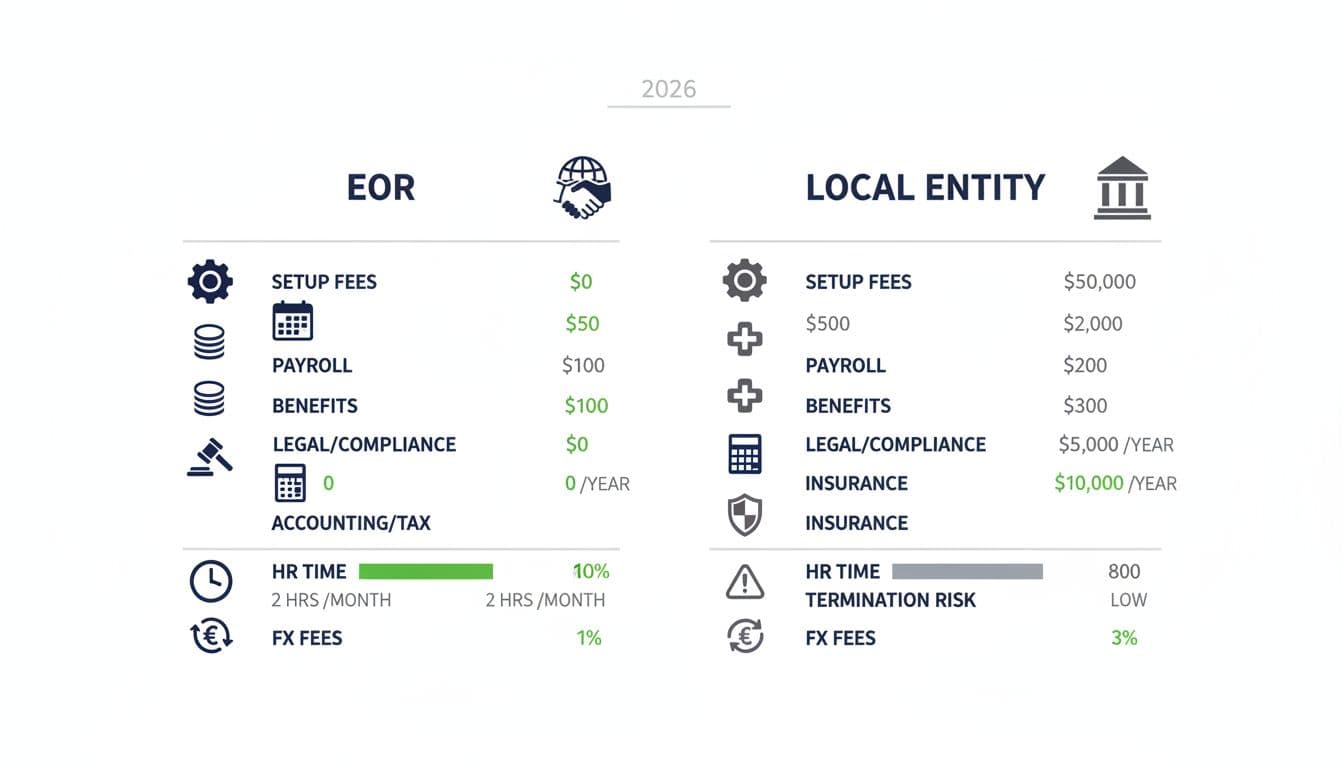
An EOR is a third party that becomes the worker’s legal employer in that country. You direct day-to-day work, but the EOR handles employment contracts, payroll, tax withholding, statutory benefits, and compliance steps that change by country. In 2026, most EOR fees land in a broad range of $200 to $1,000 per employee per month, with many companies seeing $300 to $600 as the common band, depending on country and benefits complexity.
A local entity means you register a company, open local bank accounts, set up payroll, register for tax and social contributions, and stay current on labor rules. It can be the right move, but the starting friction is real: public sources commonly cite $15,000 to $50,000 to set up, with a timeline of 3 to 12 months, plus ongoing accounting, filings, and local support.
One useful mental model: an EOR is like renting a furnished apartment, a local entity is buying the building. Renting looks more expensive per month, but you avoid the down payment, maintenance, and surprise repairs.
For background on typical EOR pricing approaches (flat fee vs percent of payroll), this EOR pricing overview is a helpful reference point.
The line-by-line cost model you can copy (with formulas)
Set up your sheet with these inputs first (you’ll reuse them everywhere):
- HC = headcount in country
- Months = planned time in country (example: 12)
- HR_rate = fully loaded hourly cost of your HR/ops/finance time
- Risk_rate = cost-of-risk per month (explained in the next section)
Then model only the incremental costs that change between EOR and entity. Salary, employer taxes, and mandatory benefits exist in both models, so keep them separate.
Copy-paste table (edit the numbers to fit your case)
| Line item | EOR cost (monthly) | Local entity cost (one-time) | Local entity cost (monthly) | Notes / formula you can paste |
|---|---|---|---|---|
| Entity registration + setup | 0 | Setup_entity | 0 | Local entity only. Setup_entity often includes legal, registrations, initial filings. |
| EOR fee | Fee_EOR * HC | 0 | 0 | Fee_EOR often $300 to $600 typical in 2026, can be higher in high-compliance countries. |
| EOR onboarding / implementation | Setup_EOR / Months | Setup_EOR | 0 | If your EOR charges a one-time setup fee, amortize it. |
| Payroll engine + local payroll vendor | Included or Payroll_EOR * HC | 0 | Payroll_entity | Entity usually needs local payroll support or software plus services. |
| Accounting + tax filings | Included | 0 | Acct_entity | Bookkeeping, VAT/GST (if applicable), annual accounts, local filings. |
| Legal + compliance counsel | Included baseline | 0 | Legal_entity | Entity often needs local counsel for templates, policy updates, terminations. |
| Insurance (EPLI, workers’ comp, etc.) | Ins_EOR * HC | 0 | Ins_entity | Depends heavily on country and role. |
| Banking + FX + payments | FX_EOR | Bank_setup | FX_entity | FX includes markups, wire fees, local payment rails. |
| HR/admin staff time | (Hrs_EOR * HR_rate) | 0 | (Hrs_entity * HR_rate) | Put real hours here, not wishful thinking. |
| Termination and severance exposure | Risk_EOR | 0 | Risk_entity | Add a monthly “risk budget” to avoid pretending it’s zero. |
| Offboarding fees | Off_EOR / Months | 0 | 0 | Some providers charge offboarding. Amortize if you expect turnover. |
Totals (simple and honest)
- EOR_total_monthly = sum(EOR cost monthly lines)
- Entity_total_monthly = sum(Local entity monthly lines)
- Entity_total_cost_over_period = Setup_entity + (Entity_total_monthly * Months)
- EOR_total_cost_over_period = (EOR_total_monthly * Months) + Setup_EOR
If you want a second opinion on what typically sits inside each model (EOR vs entity vs PEO), this explainer on EOR vs PEO vs local entity lays out the boundary lines clearly.
Pricing staff time and risk, so your model matches reality
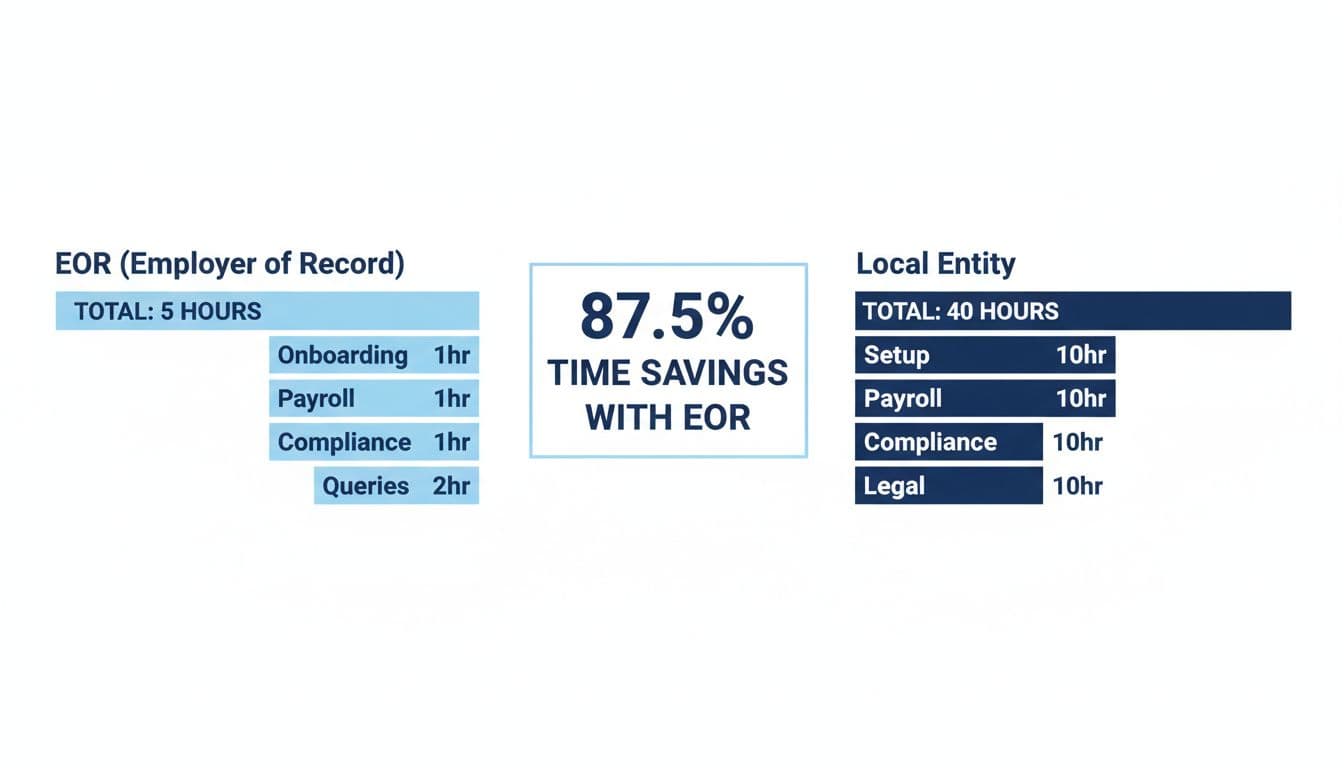
A cost model breaks when it assumes your team’s time is “free.” It isn’t. In early expansion, staff time is often the real constraint.
Staff time (hours per month) you can start with
Use these as starter assumptions, then replace them with your own reality after month one:
- EOR oversight (Hrs_EOR): 3 to 8 hours per month per country (approvals, reporting checks, employee questions).
- Local entity ops (Hrs_entity): 20 to 50 hours per month per country (payroll checks, filings coordination, benefits admin, policy updates, vendor management).
If you use a provider like Expandbase, the pitch is simple: hire and run payroll in many countries without forming entities, and push admin tasks into automated workflows. Expandbase positions itself around transparent pricing, guided onboarding (not a self-serve maze), and quick starts, with first payroll commonly running within the first week once details are in place. They also claim teams can cut HR overhead materially (in some cases up to 40 percent) and save significant weekly admin time by automating approvals and keeping audit-ready records.
Risk as a budget line, not a scary story
Risk feels “soft,” until it’s a real invoice.
Two common risk buckets in 2026:
- Worker classification risk: treating someone like an employee while paying as a contractor can trigger back taxes, penalties, and legal costs. An EOR can reduce this by employing the person properly.
- Termination and severance risk: countries vary widely on notice, severance, and documentation standards. An entity owner absorbs the process and exposure directly.
A practical way to model it:
- Risk_rate = (Estimated downside cost * Probability per year) / 12
Example: If you think a compliance event could cost $30,000 and there’s a 10% annual chance, Risk_rate is $250/month. It’s not perfect, but it forces discipline.
To sanity-check current EOR pricing ranges and what’s included, this 2026 EOR cost guide is a useful benchmark.
Quick decision rule (when entity starts to win)
Local entities get cheaper per employee as headcount grows, because fixed costs spread out. If you expect a country to be long-term and you’ll hire a bigger team there, entity economics can win. If you’re testing a market, hiring one sales rep, converting contractors, or moving fast across several countries, EOR usually wins on speed and lowered operational load.
The best model is the one you’ll actually maintain. Start with EOR when uncertainty is high, then re-run this sheet every quarter as headcount and confidence rise.
Conclusion: In 2026, the EOR vs local entity decision isn’t just fees, it’s fees plus staff time plus risk. Put all three into a simple spreadsheet, and the right answer usually becomes obvious. If you want the lowest-friction path to compliant hiring across 150+ countries, options like Expandbase are built for that first phase, when speed matters and you’d rather spend your hours on growth than paperwork.