
Hiring in the Dominican Republic can be a smart first step into Latin America, but local employment rules can trip up fast-moving teams. One wrong call on contracts, payroll, or termination can turn a simple hire into a legal headache.
That’s why a Dominican Republic employer of record matters in 2026. It gives you a legal path to hire locally, without opening your own entity first, and it keeps speed from turning into risk.
Why the Dominican Republic is attractive for hiring in 2026
The Dominican Republic keeps showing up on expansion shortlists for good reason. It offers close time-zone overlap with North America, a strong service economy, and a practical base for sales, support, operations, and market-entry hires.
Recent reporting also points to healthy momentum. According to Dominican Today’s February 2026 economic update, the economy grew 3.9% year over year in February, its best reading in 11 months. For startups and scale-ups, that matters. You’re not entering a stalled market.
At the same time, employment is not informal by default. The labor framework still protects workers strongly, and 2026 brought extra attention to pay and modern work models. Minimum wage levels rose through a phased increase, with rates varying by company size. There is also ongoing pressure to update labor rules for remote and platform work, even though the core employment code remains in place.

That mix, growth on one side and strict labor rules on the other, is exactly where an EOR helps. You get local hiring power without the cost and delay of forming a company.
How a Dominican Republic employer of record works
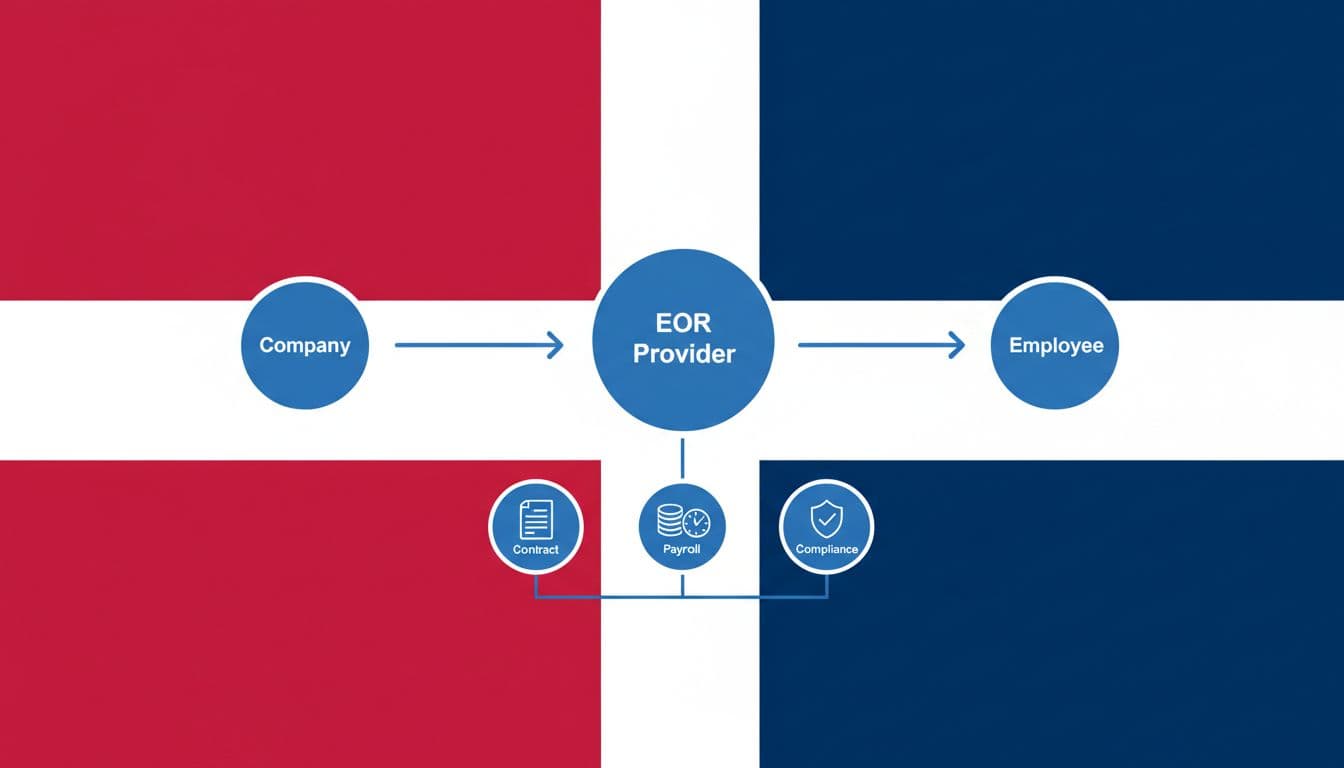
Think of an EOR as a local bridge. Your company chooses the person, role, salary, and day-to-day goals. The EOR becomes the legal employer in the Dominican Republic and handles the local employment layer, including contracts, payroll, tax withholdings, and statutory filings.
For many companies, the choice comes down to speed, cost, and risk.
| Hiring model | Time to start | Main burden | Best fit |
|---|---|---|---|
| Employer of Record | Days to a week | Service fee | Testing the market, small teams, quick entry |
| Local entity | 1 to 4 months or more | Setup, payroll, accounting, filings | Long-term local presence |
| Contractor model | Fastest | Misclassification risk | Short project work |
A strong Dominican Republic employer of record process usually follows a simple flow. First, you submit the hire details. Then the provider checks eligibility, prepares a country-ready contract, and starts digital onboarding. After that, payroll gets set up in local currency with taxes and required deductions built in.
This matters even more if you’re converting a contractor into an employee. If the person works like a full-time employee, a contractor label can be as risky as putting a paper roof on a brick house. It looks fine until the weather changes.
In the Dominican Republic, cheap hiring can get expensive if the working relationship looks like employment but the paperwork says contractor.
For a broader country snapshot, this 2026 Dominican Republic hiring guide is a useful reference alongside your provider’s advice.
Dominican Republic hiring rules employers need to watch
The core legal picture is still built around the Labor Code. A full-time schedule generally tops out at 44 hours per week, and overtime requires added pay. That alone affects budgeting for customer support, operations, and shift-based roles.
Contracts deserve extra care. Written agreements are the safer route, especially for fixed-term roles. If an arrangement keeps going without proper structure, it can start to look indefinite. That makes exits harder and more expensive later.
Leave and protected periods also matter. Employees commonly earn 14 paid vacation days after completing a year of service. Maternity protections are strong, and firing during pregnancy or shortly after birth can trigger serious issues. Public holidays also shape payroll planning, with 13 paid national holidays listed for 2026 in recent summaries.
Termination is another area where foreign employers often slip. Notice periods typically rise with tenure, often 7 days after 3 to 6 months of service, 14 days after 6 to 12 months, and 28 days after one year. If you end employment without following the right process, you may face penalty pay or severance exposure.
Payroll is not one-size-fits-all either. Many employers run payroll biweekly, and the Dominican Republic also requires a mandatory Christmas salary, often called a 13th-month payment. On top of salary, employers need to budget for social security and pension-related contributions. That’s why a cheap monthly quote from a provider can be misleading if statutory costs sit outside the proposal.
For legal background, Chambers’ Dominican Republic employment guide gives helpful context on how local labor practice works in the real world.
What to look for in an EOR provider
Not all providers solve the same problem. Some give you software and leave the hard calls to you. Others act more like a local hiring partner.
Expandbase is one option worth considering if you want speed without building an entity first. Its model is built around guided onboarding, local contract support, payroll, benefits, compliance support, and audit-ready records across 150+ countries. Based on its published approach, companies can cut a large share of the admin work tied to global hiring and avoid much of the cost that comes with entity setup.
When comparing providers, focus on a few plain questions:
- Do they explain statutory costs clearly, including taxes, benefits, and required contributions?
- Will they support onboarding and offboarding, not only payroll?
- Can they help with country-specific contracts and local rule changes?
- Do you get real support, or only a self-serve platform?
That last point matters for scaling teams. If your roadmap includes several countries, local rules will shift fast from market to market. Country guides like the Indonesia EOR Hiring Guide for 2026 and the Latvia Employer of Record 2026 Checklist show how different those details can be.
The Dominican Republic can be a strong launch market, but only if the hiring setup matches the law. A good EOR gives you room to move quickly without guessing on contracts, payroll, or termination rules.
For most startups, scale-ups, and remote-first teams, the smartest move is simple: use a Dominican Republic employer of record when you need local employees now, and decide on entity setup later if the market proves itself.