
Hiring one person in Uruguay can pull you into local contracts, payroll rules, tax setup, and ongoing HR admin. If you’re testing the market, that can feel like renting a whole building for one desk.
A Uruguay employer of record gives you a faster way in. You stay in charge of the employee’s day-to-day work, while the EOR handles the local employment layer. That matters for startups, remote-first teams, and larger companies that want speed without opening an entity first.
When a Uruguay employer of record is the smart move
Uruguay works well for first hires in Latin America. It suits sales reps, market-entry roles, remote tech hires, and small project teams. Still, local hiring isn’t something you want to patch together with a contract template from another country.
An EOR is often the best fit when you need to hire quickly but don’t want a permanent local setup yet. It’s also useful when a contractor now looks more like an employee. If you set the hours, manage the work, and fold the person into your team, the contractor model can get risky.

A strong Uruguay employer of record should cover contracts, onboarding, payroll, benefits, tax handling, and records you can pull later without a scavenger hunt. That’s where providers start to differ. Some give you software and little guidance. Others help you from offer to first payroll.
Expandbase is one option to compare. Based on its published service model, it supports hiring in 150-plus countries, helps companies avoid entity setup, and handles contracts, payroll, benefits, and compliance with guided support. Its materials also point to lower HR admin and much lower setup cost than launching a local company for a small team.
The Uruguay hiring rules that trip up foreign companies
Uruguay is business-friendly, but that doesn’t mean foreign employers can wing it. Local wage, hour, and payroll rules still apply, even if your company is based elsewhere.
Here are the main 2026 baselines to budget around:
| Item | 2026 baseline |
|---|---|
| Minimum wage | UYU 24,572 from January, rising to UYU 25,383 in July |
| Standard workweek | 44 hours |
| Weekly rest | At least 36 hours |
| Overtime | 200% of normal hourly pay |
| Overtime on holidays or rest days | 250% of normal hourly pay |
| Employer payroll costs | About 12.63% for social security and health |
Those numbers show why salary alone never tells the full story. In some industrial roles, weekly time can reach 48 hours, so role type matters too.
Uruguay also has sector-specific practices shaped by bargaining between unions and employer groups. That means benefits or work conditions can shift by industry. Probation can be used, but current 2026 summaries don’t give one simple universal rule, so local drafting matters. The same goes for termination. Don’t recycle notice or exit terms from another country and hope for the best.
A fast hire can become a slow dispute if hours, overtime, or offboarding terms are wrong on day one.
For a current outside snapshot, see Playroll’s Uruguay hiring guide. For the latest wage update, Bloomberg Tax’s report on Uruguay’s 2026 minimum wage increase is a useful check.
How the EOR hiring process works in practice
A good process should feel plain and predictable. No mystery fees, no last-minute payroll panic, and no guessing who owns the contract.
Most Uruguay EOR hires follow four simple steps:
- You share the role, pay, start date, and work location.
- The provider checks local fit, drafts a compliant contract, and collects documents.
- The employee completes onboarding and signs digitally.
- Payroll starts in local currency, with taxes, deductions, and payslips handled locally.
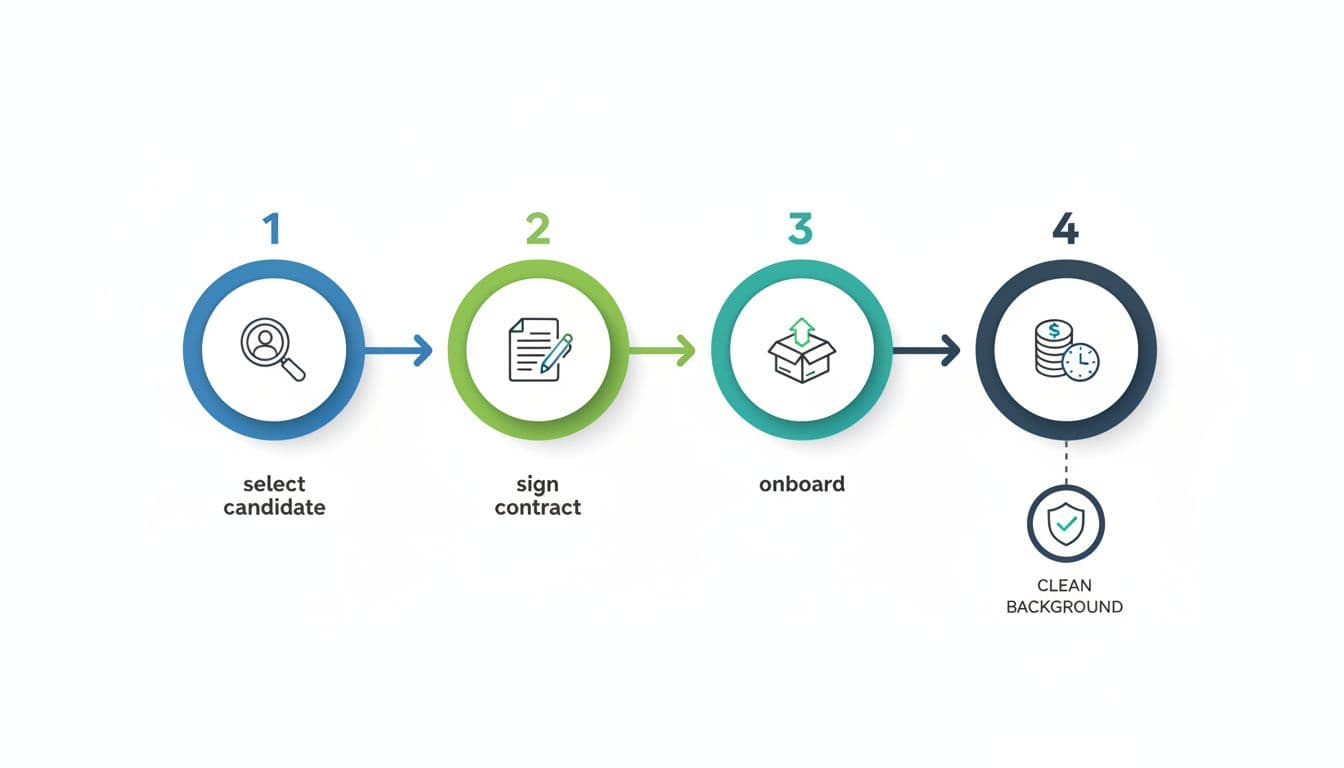
That setup can save weeks or months compared with entity formation. Expandbase says companies can move from request to onboarding much faster, with payroll and country-specific paperwork handled in one system. Its published process also emphasizes guided onboarding, transparent costs, and audit-ready records, which helps when finance and HR both need clear data.
This matters even more if Uruguay is only your first stop. If you’re also planning hires elsewhere in the region, this Peru Employer of Record checklist shows how nearby markets can look similar at a distance but follow different rules once contracts and payroll start.
Choosing the right EOR partner for Uruguay
Not every provider solves the same problem. Some are priced for pure payroll. Others are better for market entry, contractor conversion, or multi-country hiring.
Look for three things. First, pricing should be clear, including onboarding, benefits, FX, and offboarding. Second, local support should be human, not only ticket-based. Third, the provider should support growth beyond one hire.
Expandbase is worth considering if you want hands-on help instead of a self-serve setup. Its public materials focus on guided hiring, local contracts, benefits admin, payroll in local currency, and clean records that sync with HR and finance. It also positions itself as a lower-friction option for teams that want to move without getting stuck in vendor lock-in or hidden add-ons.
If you’re still comparing the market, this 2026 Uruguay EOR provider comparison gives another view of the options.
The right first step into Uruguay
If you only need one hire or a small team, opening an entity first often adds more drag than value. A Uruguay employer of record lets you hire legally, move faster, and keep risk lower while you test the market.
The best next step is simple: map the role, confirm the real employment cost, and pressure-test the provider’s contract, payroll, and support model before you sign. That’s how a quick Uruguay hire stays a smart one.